

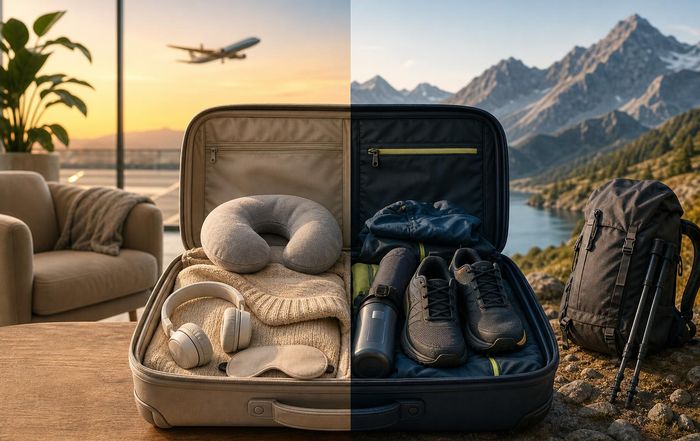
How to Balance Comfort and Performance While Traveling
Long trips can do strange things to the body and mind. One day you are in a familiar training routine, sleeping well, eating predictably; the next you are in a different time zone, cramped in a middle seat, and trying to squeeze a workout into a jet-lagged afternoon. For anyone who cares about staying active, sharp, and healthy on the move, the real challenge is not just getting from A to B, but arriving ready to perform without sacrificing basic comfort.
Balancing comfort and performance while traveling is less about heroics and more about systems: choosing the right gear, structuring the journey, and making small, consistent decisions that protect sleep, mobility, and focus. That applies whether the goal is a mountain race, a surf trip, a high-stakes business presentation, or simply feeling capable enough to explore a new city.
This exciting page brings together sports science, travel medicine, and practical experience to help travelers arrive in better shape-physically and mentally-without turning every trip into a training camp.
Start with a clear travel performance goal
Comfort and performance often clash because travelers never define which "performance" actually matters. A marathon runner flying to Berlin has different needs than a consultant on a three-city work trip or a climber heading for a week in the Dolomites. Without clarity, it is easy to overtrain, under-recover, or pack the wrong gear.
Performance goals generally fall into a few broad categories. There is pure athletic performance, where the priority is hitting a specific time, power output, or climbing grade shortly after arrival. There is cognitive performance, where alertness, decision-making, and communication matter more than speed or strength-typical for business trips, exams, and high-stakes meetings. And there is adventure performance, where endurance, resilience, and risk management across several days are key, such as trekking, ski touring, or multi-day bikepacking.
Each goal shifts the comfort-performance balance. Endurance athletes might accept some in-flight discomfort to reduce swelling and stiffness, while a jet-lagged executive may prioritize sleep and hydration above all else. Before planning, it helps to write down the one or two things that truly need to go well on the trip: a race, a pitch, a summit push, or simply staying healthy enough to enjoy the destination. This clarity makes it easier to decide where to compromise and where not to.
For readers planning active trips or events, the performance mindset naturally links with broader themes of sports, adventure, and travel, and it is worth thinking about the journey as part of the performance, not just the prelude.
Build your trip around sleep, not the other way around
Sleep is the single biggest factor in performance on the road. Research from organizations such as the American Academy of Sleep Medicine and the U.S. Centers for Disease Control and Prevention consistently shows that even one night of short sleep can impair reaction time, decision-making, and mood, while chronic sleep restriction affects immune function and injury risk. For long-haul travelers, jet lag adds another layer: the body's circadian clock can shift only about one to two hours per day, according to the Sleep Foundation and Harvard Medical School's Division of Sleep Medicine.
For trips with time-zone changes, it helps to work backward from the key performance moment. If a race, client meeting, or summit attempt is scheduled for a particular morning, plan to arrive with at least one day per time zone crossed, up to a reasonable limit, to allow partial adjustment. Tools like the Timeshifter app (developed with circadian scientists) can help create personalized jet lag plans based on flight times, light exposure, and caffeine timing, aligning with guidance from sources such as the Sleep Foundation and Harvard Health Publishing.
On the plane, comfort choices should revolve around sleep protection. That includes neck support, eye masks to block cabin lighting, and choosing seats away from galleys and toilets when possible. Even economy-class travelers can improve rest by using a footrest strap or small inflatable cushion to reduce lower-back strain and pressure behind the knees, which also lowers the risk of swelling. Airlines such as Qantas and Singapore Airlines now publish in-flight wellness advice that aligns broadly with clinical recommendations.
On the ground, maintaining a consistent sleep window matters more than squeezing in late-night training. Blue-light reduction, cool and dark hotel rooms, and a simple pre-sleep routine-stretching, reading, or breathing exercises-can be more valuable than another rushed workout. For those balancing ambitious itineraries with rest, this intersects closely with broader lifestyle choices and how sustainable their travel habits feel over time.
Pack a minimalist "performance comfort" kit
Travel gear can easily become an overstuffed security line headache, but a small, purpose-built kit can do more for comfort and performance than an extra pair of shoes. The goal is to support circulation, mobility, and recovery without overloading your carry-on.
Most sports medicine and travel health organizations, including the World Health Organization and International Society of Travel Medicine, emphasize three pillars for long journeys: movement, hydration, and posture. Compression socks or sleeves, when properly fitted, can reduce leg swelling and lower the risk of deep-vein thrombosis in long-haul flights, a benefit highlighted in guidance from the UK National Health Service. A lightweight lumbar roll or foldable cushion supports spinal alignment in unsupportive seats, and a quality neck pillow-ideally with adjustable support rather than simple foam-can prevent the kind of awkward head positions that cause post-flight headaches and stiffness.
For performance-focused travelers, adding a compact recovery tool such as a mini massage ball, resistance band, or lightweight travel roller can be transformative. These allow quick mobility routines in hotel rooms, airport corners, or even quiet gate areas. Teams in professional cycling, football, and athletics routinely travel with such tools; organizations like Team GB and USA Track & Field have publicly discussed how simple mobility work on travel days reduces injury risk during competition weeks.
A minimalist kit might also include a refillable water bottle, eye mask, earplugs or noise-cancelling headphones, and a small snack pack with familiar, easily digestible foods. These support both comfort and performance by stabilizing energy and reducing reliance on unpredictable airport or airline catering. Travelers interested in optimizing this side of the journey often gravitate toward broader performance and innovation coverage, where emerging gear and materials frequently appear.
Move early, move often: circulation and stiffness
Sitting still for hours is a problem for both health and performance. The World Health Organization identifies physical inactivity as a major risk factor for noncommunicable diseases, and prolonged immobility is a recognized contributor to venous thrombosis on long-haul flights. For athletes and active travelers, the more immediate issue is stiffness and reduced range of motion, which can linger for days and undermine training or adventure plans.
Movement does not need to be dramatic. Standing or walking every 60-90 minutes on flights or trains, even for a few minutes, helps circulation. Simple ankle pumps, calf raises, seated marches, and gentle spinal rotations can all be done in tight spaces. Airlines such as Air New Zealand and Lufthansa provide in-seat exercise guides that, while basic, align with physiotherapy advice for maintaining blood flow and joint mobility.
Before and after travel, short sessions of dynamic mobility work can act as a "buffer" against the effects of sitting. These might include hip openers, thoracic spine rotations, and light activation exercises for glutes and core. The goal is not to fatigue the body but to keep the neuromuscular system engaged. Many endurance coaches, including those working with elite marathoners and triathletes, recommend replacing heavy training on travel days with these lighter routines, a practice reflected in coaching resources from groups like World Athletics and USA Triathlon.
For travelers heading into demanding adventure or destination experiences-a trek, a surf camp, a ski week-this movement-first approach helps ensure that the first day is not wasted on stiff, underperforming legs or a tight lower back.
Train smart around travel, not through it
Many active travelers try to "cram" training into the days before a trip or maintain full workloads in the middle of complex itineraries. Sports science suggests this is usually counterproductive. Studies summarized by organizations such as the Australian Institute of Sport and World Athletics indicate that fitness does not decline significantly over a few easy days, but excessive fatigue combined with travel stress increases injury risk and compromises later performance.
A more effective strategy is to treat travel as a light-load period within a larger training cycle. Two to three days before departure, keep intensity but slightly reduce volume, allowing the body to freshen up without losing neuromuscular sharpness. On the travel day itself, focus on movement, hydration, and sleep rather than hard sessions. The first day or two after arrival can feature short, low-intensity workouts to "recalibrate" in the new environment, with serious efforts scheduled once sleep and digestion have stabilized.
For business travelers or those juggling work and training, this may mean accepting that not every trip is the moment to chase personal records. Instead, the performance target could be maintaining a base level of fitness and mobility. Many high-performing professionals, including executives and frequent-flyer consultants, now treat in-trip exercise as maintenance rather than progression, focusing on 20-30 minute sessions that combine mobility, light strength, and moderate cardio. This approach respects the cumulative fatigue of time zones, meetings, and social obligations while preserving long-term health and capability.
Readers interested in how training and travel interact in professional sport can often find relevant examples in sports and performance coverage, where teams and athletes routinely adapt competition schedules to minimize travel disruption.
Eat and hydrate for stability, not perfection
Nutrition on the move is rarely ideal. Airport food courts, late hotel dinners, and unfamiliar cuisines can all disrupt digestion and energy levels. The aim is not to eat perfectly but to maintain stability: avoiding large swings in blood sugar, gastrointestinal distress, and extreme dehydration.
Guidance from organizations like the Academy of Nutrition and Dietetics and the International Society of Sports Nutrition emphasizes consistent hydration, moderate fiber intake during travel, and familiar foods around key performance moments. On flight days, drinking small amounts of water regularly is more effective than occasional large volumes, particularly in low-humidity cabins where fluid loss is higher. Alcohol and high-caffeine energy drinks can worsen sleep and dehydration, especially when consumed late in the journey; both should be used strategically, if at all.
For long-haul flights, lighter meals with a balance of carbohydrates, protein, and healthy fats are easier on the stomach than heavy, greasy options. Bringing simple snacks-nuts, fruit, oat bars, or sports nutrition products you already tolerate well-reduces reliance on unpredictable airline meals. If a major race or event is scheduled soon after arrival, many sports dietitians recommend sticking to familiar foods in the 24-48 hours beforehand, even if that means seeking out international chains or grocery stores instead of relying solely on local specialties. This is a recurring theme in elite competition coverage, including Olympic and World Cup events, where teams often travel with their own chefs or controlled food supplies.
At the same time, travel is also about culture and enjoyment. Once the key performance moments have passed, exploring local food becomes part of the experience and connects directly to culture and lifestyle interests. The art is in timing: protect the body when it most needs stability, then relax the rules when the stakes are lower.
Manage stress and cognitive load on the move
Performance is not only physical. Cognitive fatigue-driven by logistics, uncertainty, and constant decision-making-can be just as draining as jet lag. Research from the American Psychological Association and World Health Organization highlights how chronic stress impairs sleep, immune function, and executive function, all of which matter for travelers trying to perform in unfamiliar environments.
Practical steps can significantly reduce this load. Pre-planning key logistics-airport transfers, hotel check-in, local SIM or eSIM options, and backup routes-removes a surprising amount of background anxiety. Saving offline maps, boarding passes, and critical documents reduces dependence on patchy connectivity. For work travelers, blocking calendar time after arrival (rather than stacking meetings immediately) allows decompression and a short walk or light workout to reset.
Simple mental routines also help. Short breathing exercises, such as box breathing or 4-7-8 patterns, can calm the nervous system in cramped cabins or stressful queues; these techniques are widely endorsed in resources from groups like NHS Every Mind Matters and Headspace. Some athletes and high-performance professionals use brief visualization sessions on flights to rehearse races, presentations, or complex tasks, a practice supported by sports psychology research summarized by organizations like the Association for Applied Sport Psychology.
Comfort choices-noise-cancelling headphones, familiar playlists, or offline reading-are not indulgences; they are tools for preserving mental bandwidth. This is particularly relevant for travelers whose journeys combine business objectives with physically demanding activities, such as executives squeezing in mountain runs or surf sessions around meetings.
Respect safety limits when pushing performance
Chasing performance while traveling can nudge people toward riskier decisions: training in unfamiliar neighborhoods at night, pushing through illness, or exploring remote trails without proper preparation. Balancing comfort and performance also means respecting safety limits, especially in environments where emergency support or medical care may be slower or more complex.
Travel medicine resources from the Centers for Disease Control and Prevention and the World Health Organization emphasize pre-trip health assessments, vaccination where appropriate, and awareness of climate, altitude, and local medical infrastructure. For adventure travelers, altitude is a particular concern; organizations such as the International Society for Mountain Medicine and UIAA (International Climbing and Mountaineering Federation) publish guidelines on acclimatization, ascent rates, and recognizing early signs of altitude illness. Ignoring these in pursuit of a summit or fast ascent can have serious consequences.
Urban safety matters too. Runners and cyclists exploring new cities should consider visibility, traffic norms, and local advice about safer routes and times of day. Many hotel concierges, local clubs, or online communities can recommend established loops or group sessions. Carrying basic ID, a charged phone, and letting someone know your route are simple but important safeguards.
From a broader perspective, this intersects with travel safety, ethics, and world considerations: respecting local regulations, avoiding environmentally sensitive areas, and understanding cultural norms around dress and behavior in public spaces, especially when exercising.
Design itineraries that respect human limits!
Some trips fail not because of a single bad decision but because the entire itinerary was unrealistic from the start. Back-to-back red-eyes, multiple time zones in short succession, or long drives immediately after overnight flights all compound fatigue and risk. High-performance environments such as professional sport and aviation have learned this the hard way; scheduling now often includes travel recovery windows and strict duty-time limits.
Individual travelers can borrow this mindset. When planning, it helps to map not just flights and meetings but also sleep opportunities, movement windows, and meals. If a key performance moment falls soon after arrival, consider arriving a day earlier or choosing a route that minimizes layovers, even if it is slightly more expensive. For multi-stop trips, grouping destinations by time zone or direction of travel can reduce circadian disruption, a strategy reflected in some corporate travel policies and tournament schedules.
It is also worth recognizing that "doing everything" on a single trip is rarely compatible with high performance. Choosing fewer destinations or activities but doing them well often leads to better experiences and less exhaustion. This is particularly true for active holidays, where the temptation to pack in hikes, rides, and climbs every day can leave travelers returning home more depleted than when they left.
Readers interested in how itinerary design intersects with broader economic and cultural forces can find related threads in travel, world, and business coverage, where airline networks, remote work, and tourism patterns all shape how and why people move.
Bringing it together: a practical travel framework
Balancing comfort and performance on the road is less about any single hack and more about aligning a few key pillars: sleep, movement, nutrition, mental load, and safety. For most travelers, a simple framework can guide decisions without turning every trip into a project.
First, define the primary performance goal and accept that other ambitions may need to be secondary. Second, build the travel plan around sleep opportunities, using tools and practices that support circadian adjustment and in-flight rest. Third, treat movement as non-negotiable: light, frequent, and focused on mobility rather than intensity during the heaviest travel days. Fourth, aim for nutritional stability and hydration, using familiar foods and consistent fluid intake to avoid extremes. Fifth, reduce avoidable stress through planning and simple mental routines, keeping bandwidth for the moments that matter. Finally, respect safety and ethical boundaries, remembering that no personal record or presentation is worth a serious health or security incident.
Travel will always involve some discomfort and unpredictability. Yet with a performance-informed approach, the journey can support rather than sabotage what happens at the destination-whether that is a finish line, a boardroom, a remote trail, or simply a new city waiting to be explored.