

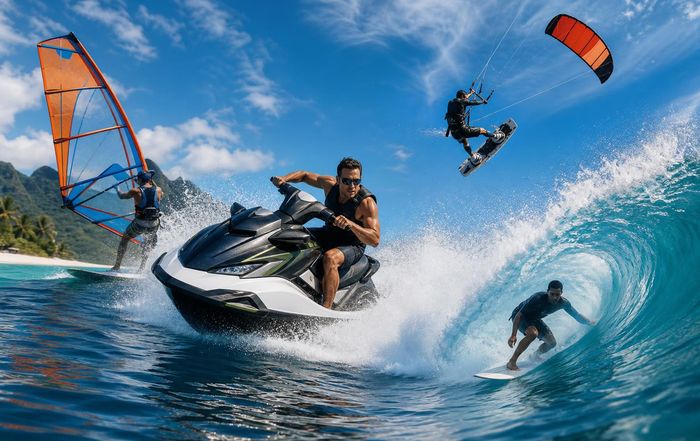
Water Sports That Combine Skill, Speed, and Adventure
From glassy dawn surf breaks to white-knuckle river descents, water sports sit at the intersection of skill, speed, and pure adrenaline. For many adventure-minded athletes, the appeal is as much about reading the water and mastering technique as it is about going fast or pushing comfort zones.
This guide explores some of the most dynamic water sports where technical ability and decision-making matter as much as bravery. It also looks at safety, progression, and how to choose the right discipline for your body, environment, and appetite for risk.
Surfing: Reading Ocean Energy at Speed
Modern surfing is a blend of ocean literacy, board control, and fast-twitch reactions. At its core, the sport is about harnessing the energy of a moving wave and converting it into speed, flow, and maneuvers along the face.
Shortboard high-performance surfing, as seen on the World Surf League (WSL) Championship Tour, demands explosive turns, aerials, and split-second positioning on steep, powerful waves. Surfers must constantly adjust to shifting sandbanks, swell direction, and wind conditions, all of which are monitored in detail by forecasting platforms like Surfline and Magicseaweed.
Yet even in less extreme beach-break conditions, surfing is technically demanding. Paddling efficiency, wave selection, and timing the pop-up are all learned skills rather than innate talents. Many beginners underestimate how much fitness and ocean awareness are required, especially in rip-prone areas or colder waters such as the North Atlantic.
Safety-wise, national bodies such as the Royal National Lifeboat Institution (RNLI) in the UK publish guidance on surf zone safety and rip currents, emphasizing basic rules: surf between the flags where lifeguards operate, never surf alone in unfamiliar breaks, and understand local hazards such as rocks, reefs, and tidal races.
For people interested in performance progression and ocean-driven adventure, surfing naturally overlaps with themes covered in sports, adventure, and destination coverage, from remote reef passes to urban beach breaks.
Kitesurfing and Wingfoiling: Harnessing Wind and Water
Kitesurfing (or kiteboarding) and the newer discipline of wingfoiling combine wind power with board sports, creating fast, highly maneuverable experiences on open water.
Kitesurfers use an inflatable or foil kite connected via lines and a control bar to generate pull, riding a twin-tip, surfboard, or foil board. The sport has evolved into several sub-disciplines: freeride, big air, freestyle, wave riding, and racing. Competitive kite racing is now recognized at the Olympic level, with the Formula Kite class set for future Games after kiteboarding made its debut in a modified form at Paris 2024.
Wingfoiling, by contrast, uses a handheld wing (not attached via lines) and a hydrofoil board. The foil lifts the rider above the water at speed, reducing drag and allowing for smooth gliding even in choppy conditions. The Global Wingsports Association (GWA) oversees wingfoil world tour events, where riders mix racing with aerial tricks.
Both sports require nuanced kite or wing control, strong situational awareness, and the ability to self-rescue if equipment fails or wind drops. Most accidents occur when beginners attempt to self-teach with oversized kites or in unsuitable wind. Organizations like the International Kiteboarding Association and safety-focused brands strongly recommend formal lessons, helmet use, and impact vests, especially in crowded or gusty spots.
Kitesurfing and wingfoiling often intersect with travel and lifestyle choices, as riders chase trade winds in places like Tarifa, Cape Town, Hood River, and Brazil's northeast coast. For those interested in wind-driven adventure and performance, they connect naturally to travel and performance themes, including gear innovation and athlete training.
Whitewater Kayaking and Rafting: Technical Lines in Moving Water
Whitewater sports turn rivers into dynamic obstacle courses. Whether in a compact creek boat or a six-person raft, paddlers must read currents, eddies, and hydraulics in real time, choosing lines that balance speed and safety.
Whitewater kayaking branches into several disciplines:
Creeking: steep, technical rivers with drops and slides
River running: continuous rapids over longer distances
Playboating: tricks and surfing on standing waves or holes
Extreme racing: timed descents on demanding courses
Organizations like American Whitewater maintain detailed river classifications and safety information, using the international Class I-VI system to grade difficulty. Progression typically involves professional instruction, pool sessions for rolling practice, and guided trips on Class II-III rivers before tackling more serious whitewater.
Commercial rafting, while often marketed as a group thrill, still depends heavily on guide skill. Guides must interpret flows, manage risk, and coordinate paddling crews. In countries with strong river-running cultures, such as the United States, New Zealand, and Chile, rafting also intersects with conservation, as river access and dam projects remain contentious issues. The International Rafting Federation provides training and safety standards for guides globally.
For readers drawn to adventure and river destinations, whitewater sports align closely with adventure, safety, and world coverage, often highlighting how local communities balance tourism, ecology, and risk.
Wakeboarding and Wakesurfing: Boat-Powered Progression
Wakeboarding and wakesurfing bring board sports to lakes and coastal inlets, using boat-generated wakes instead of natural waves or wind.
Wakeboarding resembles a blend of waterskiing and snowboarding. Riders use a fixed line attached to a boat or cable system, carving across the wake and performing jumps and spins. Modern wake boats, equipped with ballast systems and wake-shaping tabs, create steep, customizable wakes that allow advanced riders to push technical limits. Professional tours such as the Pro Wakeboard Tour showcase increasingly complex trick combinations, with strict judging criteria on amplitude, difficulty, and style.
Wakesurfing, by contrast, uses a shorter rope only for the start. Once up, the rider drops the rope and surfs the boat's wave at close range. This demands fine foot pressure control and constant micro-adjustments to stay in the pocket. Because speeds are lower than in wakeboarding, some newcomers perceive wakesurfing as less intimidating, though proximity to the boat still requires disciplined safety protocols.
Regulation and environmental concerns have grown alongside the sports' popularity. Some lakes now impose restrictions on wake size, distance from shore, or ballast use due to shoreline erosion and noise complaints. The Water Sports Industry Association (WSIA) publishes best-practice guidelines under its "Wake Responsibly" campaign, urging riders to keep distance from shorelines and other water users.
Wake sports also reflect broader lifestyle and business trends, from high-end boat brands to cable parks that make riding more accessible and less fuel-intensive. These developments intersect with business and brands coverage, as manufacturers compete through hull designs, ballast tech, and eco-focused innovations.
High-Speed Sailing and Foiling: Flight Above the Water
Sailing is often associated with leisurely cruising, but at the performance end it becomes a high-speed, highly technical pursuit. Foiling dinghies, catamarans, and boards now "fly" above the water on hydrofoils, slashing drag and achieving speeds that were once unimaginable for sail-driven craft.
The America's Cup has been a major driver of this trend. The AC75 foiling monohulls used in recent editions regularly exceed 40 knots, with teams relying on advanced simulation, aerospace-grade materials, and real-time data analytics. The official America's Cup website details how flight controllers manage foil angle, sail trim, and boat attitude to maintain stable flight.
At a more accessible level, classes like the International Moth and Waszp offer one-person foiling dinghies where sailors must coordinate balance, sail control, and foil trim. Mistakes at speed can lead to dramatic crashes, so protective gear and structured progression are essential.
Offshore racing also showcases high-speed sailing skills. Events such as the Vendée Globe and The Ocean Race require skippers to manage extreme weather, sleep deprivation, and complex routing decisions over weeks at sea. The World Sailing governing body provides safety regulations and offshore training standards, emphasizing emergency preparedness and weather literacy.
For readers interested in innovation and performance, foiling and offshore racing blur the lines between sport, engineering, and adventure, tying neatly into innovation and sports themes.
Freediving and Spearfishing: Slow Heartbeats, High Consequences
Not all high-adventure water sports rely on speed across the surface. Freediving and spearfishing trade horizontal velocity for depth, breath-hold, and intense mental focus. They still demand significant skill and carry serious risk, which is why they belong in any discussion of high-stakes aquatic pursuits.
Competitive freediving sees athletes descend on a single breath to impressive depths, often using a weighted sled or monofin. Organizations such as AIDA International and CMAS sanction world record attempts and competitions, with strict safety protocols including safety divers, counter-ballast systems, and medical oversight. Elite freedivers can surpass 100 meters in constant weight disciplines, but blackouts and barotrauma remain real hazards even for experienced practitioners.
Recreational freediving and spearfishing emphasize technique-relaxed breathing, equalization, streamlined finning, and buddy communication. Safety guidelines universally stress never diving alone, avoiding hyperventilation, and receiving formal instruction from certified schools such as those recognized by PADI or SSI, which both provide freediving training frameworks.
Spearfishing adds ethical and environmental dimensions. Responsible hunters focus on selective, sustainable catches, respecting local regulations and marine protected areas. In many coastal cultures, from the Mediterranean to the Pacific Islands, spearfishing is deeply woven into food traditions and community identity, linking sport to culture and ethics as much as to adventure.
Big-Wave Surfing and Tow-In: When Scale Becomes the Challenge
At the extreme end of surfing, big-wave riders tackle swells exceeding 20-30 feet, often at breaks like Nazaré in Portugal, Jaws (Peʻahi) in Hawaii, and Mavericks in California. Here, the primary challenge is not just maneuvering on the wave but surviving wipeouts that can hold surfers underwater for multiple wave cycles.
Tow-in surfing, where a jet ski tows a surfer onto waves too fast to paddle into, helped open this realm in the 1990s. Today, many big-wave surfers also paddle into giant waves using oversized guns (long, narrow surfboards) and specialized leashes and flotation vests. The World Surf League's Big Wave Awards highlight feats in this discipline, with Nazaré's record-setting rides drawing global attention.
Safety protocols are extensive. Teams typically include rescue drivers on skis, spotters with radios, and medical staff on shore. Surfers train breath-hold, cardiovascular conditioning, and mental resilience. Research into surf-zone trauma and drowning, such as studies referenced by the International Surfing Association (ISA) and academic journals, underscores how quickly conditions can overwhelm even experts.
For most enthusiasts, big-wave surfing is more inspiration than aspiration, but it illustrates how far the combination of skill, speed, and adventure can be pushed-and how tightly it must be coupled with safety planning and respect for natural forces.
Choosing the Right High-Adventure Water Sport!
With so many options, deciding where to invest time, money, and training can feel overwhelming. A few practical filters can help.
Environment is often decisive. Coastal residents may naturally gravitate toward surfing, kitesurfing, or coastal sailing, while those near lakes and rivers might focus on wake sports, whitewater kayaking, or flatwater disciplines that still offer speed and technical depth, such as sprint canoe and kayak. Climate and water temperature also matter: cold-water environments demand more gear investment and safety planning but can be less crowded and uniquely rewarding.
Risk tolerance and learning style are equally important. Sports like whitewater kayaking, big-wave surfing, and technical freediving have steeper risk profiles and narrower margins for error. They reward patient, structured progression and a strong safety culture. Others, such as wakesurfing or beginner-level kitesurfing under instruction, can offer high enjoyment with more controlled environments, especially when guided by certified schools that follow recognized safety standards from bodies like World Sailing, AIDA, or national lifeguard associations.
Cost and access vary widely. Sailing foilers, high-end wake boats, and frequent kite trips to wind-reliable destinations can be expensive. By contrast, river kayaking, surfing with a mid-range board and wetsuit, or joining a local rowing or outrigger canoe club can be comparatively affordable once initial gear is purchased. Many national federations and clubs, from British Canoeing to USA Surfing, list local clubs and beginner programs that make entry more accessible.
Finally, consider what kind of satisfaction you seek: explosive tricks, endurance challenges, technical problem-solving, or meditative immersion. High-speed sailing and wakeboarding reward precision and data-driven progression; surfing and river running emphasize reading natural rhythms; freediving and spearfishing focus on internal calm and intimate interaction with marine ecosystems.
The Common Thread: Respecting Water, Chasing Mastery
Across all these sports-surfing, kitesurfing, whitewater, wake, foiling, freediving, and big-wave riding-the constants are respect for water, commitment to skill development, and an appetite for calculated risk. The most accomplished practitioners are rarely the loudest thrill-seekers; they are meticulous planners who study forecasts, understand equipment, and maintain conservative safety habits even as they pursue ambitious goals.
For those drawn to high-adventure lifestyles, these disciplines offer more than momentary adrenaline. They shape travel plans, influence gear choices, and connect people with coastal and river communities around the world. They also intersect with broader conversations about access, environmental stewardship, and innovation that run through areas like lifestyle, world, and innovation.
Whether the next step is booking a beginner surf lesson, joining a whitewater club, or simply spending time understanding local tides and river flows, the path into water-based adventure starts the same way: learn first, move gradually, and let speed and challenge emerge naturally from solid skills and informed respect for the water.