

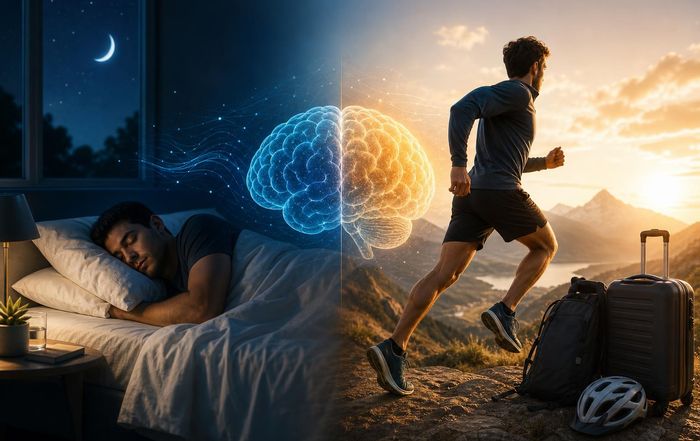
How Sleep Shapes Performance in Sports and Travel
For athletes and frequent travelers, sleep is often the first thing sacrificed to early flights, late games, and packed schedules. Yet decades of research show that sleep is not a luxury add-on to performance; it is one of its core drivers. From reaction times on a mountain bike descent to decision-making in a business meeting after a red-eye, how and when you sleep can change outcomes in ways that are both measurable and surprisingly large.
This guide explores what sleep actually does for the body and brain, how it affects sports and travel performance, what happens when you cross time zones, and how to build practical routines that work in real life rather than in a lab.
What Sleep Really Does for Performance
Sleep is not passive downtime. During a normal night, the brain moves through cycles of non-REM and REM sleep that support recovery, learning, and emotional regulation. Research from the National Institutes of Health shows that deep non-REM sleep is closely linked to tissue repair, immune function, and hormone regulation, while REM sleep is critical for memory consolidation and emotional processing.
For athletes and active travelers, three functions are particularly important:
Physical recovery and adaptation: Deep sleep is when growth hormone peaks, supporting muscle repair and adaptation after training or long days on the move. Studies in journals such as Sleep and Medicine & Science in Sports & Exercise show that sleep loss can impair muscle glycogen restoration and recovery, making back-to-back sessions or multi-day adventures feel much harder.
Motor learning and skill retention: The brain uses sleep to consolidate new skills, including complex movement patterns. A review in Sports Medicine notes that sleep plays a key role in motor sequence learning and accuracy, which matters for everything from climbing technique to tennis footwork.
Cognitive performance and decision-making: Sleep supports attention, working memory, and executive function. The U.S. Centers for Disease Control and Prevention (CDC) highlights that even moderate sleep loss can lead to slowed reaction times and poorer judgment, similar in magnitude to mild alcohol intoxication.
These same mechanisms apply whether someone is competing in elite sport, heading off on a trekking expedition, or flying across continents for work.
Sleep and Sports: From Sprint Times to Strategy
Measurable performance changes
Controlled studies with athletes make it clear that sleep quantity and quality directly affect performance. Research led by Stanford University found that basketball players who extended their sleep to around 10 hours per night improved sprint times and shooting accuracy. Similar work in swimmers and tennis players has shown better reaction times and serve accuracy with extra sleep.
On the flip side, short sleep impairs both endurance and power:
A study in European Journal of Applied Physiology reported that partial sleep deprivation reduced time to exhaustion and peak power output.
Research on team-sport athletes has linked short sleep duration with reduced sprint performance and increased perceived exertion.
In practical terms, that translates to slower starts, weaker finishes, and a higher sense of effort for the same workload.
For readers interested in broader training context, the performance angle connects naturally with topics covered in our sports and performance sections, where recovery is treated as part of training-not an afterthought.
Injury risk and overtraining
Sleep also plays a protective role. A study of high school athletes published in the Journal of Pediatric Orthopaedics found that those sleeping fewer than 8 hours per night were significantly more likely to suffer injuries than their better-rested peers. Mechanisms include impaired reaction time, reduced proprioception, and slower neuromuscular responses.
For endurance athletes and adventure enthusiasts, chronic short sleep is associated with symptoms that resemble overtraining: persistent fatigue, plateaued or declining performance, mood changes, and higher resting heart rate. The American College of Sports Medicine notes that insufficient recovery, including sleep, is a major contributor to overreaching and overtraining syndromes.
For those exploring high-risk environments-alpine routes, remote trails, or backcountry skiing-sleep interacts directly with safety. Impaired judgment, slower decision-making, and reduced situational awareness increase the likelihood of accidents, a theme we regularly explore in our safety and adventure coverage.
Tactics, decision-making, and "clutch" moments
Team sports and tactical disciplines-football, basketball, combat sports, motorsport-depend not just on physical output but on rapid information processing. Experimental work with sleep-restricted individuals shows:
Slower response to visual and auditory cues.
More frequent lapses of attention ("microsleeps").
Poorer risk assessment and increased impulsivity.
The American Academy of Sleep Medicine summarizes that sleep deprivation impairs cognitive flexibility and decision-making, which can decide outcomes in close contests or complex adventure scenarios such as route-finding during an ultra-distance race.
Elite teams increasingly track sleep alongside GPS and heart-rate data, treating it as a modifiable performance variable. But the same principles apply to recreational athletes: the night before a big competition or expedition is not the time to be catching up on a week of missed sleep.
Sleep on the Move: Travel, Jet Lag, and Adventure
Why travel disrupts sleep so easily
Travel performance is influenced by several overlapping factors: time zone shifts, early departures or late arrivals, unfamiliar sleeping environments, and sometimes altitude or temperature changes. Each can interfere with the body's circadian rhythm-the internal 24-hour clock regulated by light, hormones like melatonin, and regular routines.
The Sleep Foundation notes that jet lag occurs when the circadian rhythm is misaligned with local time, leading to insomnia, daytime sleepiness, digestive issues, and reduced alertness. Even without crossing time zones, irregular schedules and poor sleep environments (noisy hotels, overnight buses, bright city lights) degrade sleep quality.
For travelers combining long-haul flights with physically demanding plans-mountain trekking, surf trips, ski holidays, or multi-day bikepacking-this mismatch between exertion and recovery can be especially pronounced.
Our travel and destination sections frequently highlight that logistics and rest are as important as gear when planning high-output itineraries.
Jet lag and athletic performance
Jet lag is not just an annoyance; it has measurable performance effects. Research involving professional and collegiate teams has found that crossing multiple time zones, especially flying east, can:
Reduce win percentages for teams traveling across time zones, as shown in analyses of Major League Baseball and NBA schedules reported in journals like PNAS and Sleep Medicine.
Impair sprint performance, reaction time, and perceived exertion for several days after arrival, according to controlled studies on eastward and westward travel.
The International Olympic Committee (IOC) has published consensus statements on jet lag and travel fatigue that emphasize pre-travel planning, gradual schedule shifts, and light exposure management as key strategies, especially when competitions start soon after arrival.
Recreational travelers often underestimate these effects. A multi-pitch climb, off-piste ski day, or long trail run completed in a jet-lagged state can feel disproportionately demanding and may carry higher risk.
Sleep, safety, and transport
Sleep-related impairment is a major safety issue in travel itself. The World Health Organization and national road safety agencies consistently warn that drowsy driving increases crash risk; the National Highway Traffic Safety Administration (NHTSA) in the United States attributes thousands of crashes each year to fatigue and drowsy driving.
For adventure travelers driving long distances to remote areas, or those renting vehicles in unfamiliar countries, sleep becomes a core safety variable. Similar concerns apply to pilots, expedition leaders, and guides, where fatigue management is increasingly formalized through duty-time regulations and monitoring.
Readers interested in the broader intersection of travel, safety, and regulation can find related themes in our world and news coverage, where fatigue has featured in investigations into transport incidents and workplace risk.
How Much Sleep Do Active People Really Need?
There is no single perfect number, but guidelines give useful ranges. The American Academy of Sleep Medicine and Sleep Research Society recommend that adults aim for at least 7 hours per night for optimal health, with many athletes benefiting from 8-10 hours, especially during heavy training blocks or multi-day expeditions.
Key points for active individuals:
Baseline: Consistently under 7 hours is linked to impaired performance, mood, immune function, and increased injury risk.
High-load phases: During intense training, competition blocks, or demanding travel, extending sleep by 30-90 minutes (including naps) often improves performance and perceived recovery.
Individual variation: Genetics, age, and training history matter. Some people function well at the lower end of the range, but chronic short sleepers are rare, and many who believe they "do fine on 5-6 hours" show measurable deficits when tested.
The World Sleep Society emphasizes regularity-going to bed and waking up at similar times-as a key factor in healthy sleep, which also supports consistent training and travel routines.
Common Sleep Disruptors for Athletes and Travelers
Training and competition timing
Late-evening training or competition can delay sleep onset by raising core body temperature, elevating adrenaline, and increasing mental arousal. Night games, late-finishing endurance events, and evening gym sessions often push bedtimes later, particularly when combined with post-event socializing or travel.
Caffeine use around training further complicates this. The European Food Safety Authority (EFSA) notes that caffeine's half-life averages 3-5 hours, meaning late-day consumption can interfere with sleep even if subjective tiredness is present.
Stress, pressure, and pre-event anxiety
Before important competitions, expeditions, or business trips, anxiety often disrupts sleep. Studies of athletes at major events such as the Olympic Games and World Championships have found that pre-competition nights are frequently characterized by reduced sleep duration and poorer quality, driven by worry, excitement, and irregular schedules.
This effect is not limited to elite sport. Adventure travelers heading into remote regions or high-risk activities may experience similar anticipatory stress, especially when logistics or conditions are uncertain.
Environment and technology
Hotel rooms, shared dorms, night trains, and airplanes bring unfamiliar noise, light, and temperature profiles that disrupt sleep. Blue light from screens can delay melatonin release, shifting the circadian clock later. The Harvard Medical School Division of Sleep Medicine explains that blue-wavelength light in the evening suppresses melatonin and shifts circadian timing, making it harder to fall asleep.
For travelers relying on smartphones or tablets for navigation, communication, and entertainment, screen exposure is hard to avoid, but the timing and brightness can be adjusted to reduce impact.
Practical Sleep Strategies for Athletes and Adventurous Travelers
Sleep science is complex, but performance-oriented strategies do not have to be. The challenge is fitting them into real-world constraints such as early flights, late games, and changing time zones.
Building a performance-friendly sleep routine
For most active people, a few consistent habits make a substantial difference:
Anchor wake time: Keeping wake-up times relatively stable helps regulate circadian rhythm, even if bedtimes occasionally slip later due to training or travel.
Wind-down period: A 30-60 minute pre-sleep routine-stretching, reading, or light mobility work-signals the body to shift toward rest. This can be especially helpful on the eve of competitions or long travel days.
Control light and temperature: Cool, dark, and quiet environments support deeper sleep. Eye masks, earplugs, and simple travel fans or adjusting room thermostats can help replicate home conditions on the road.
Strategic caffeine use: Limiting caffeine intake in the 6 hours before planned sleep reduces sleep-onset latency for many individuals, while still allowing performance benefits earlier in the day.
These habits align with broader lifestyle optimization themes we explore in our lifestyle coverage, where sleep sits alongside nutrition, stress, and movement.
Naps as a performance tool
When night-time sleep is limited, naps can partially compensate. Research in Sports Medicine and other journals indicates that short daytime naps (20-30 minutes) can improve alertness and reaction time, particularly in sleep-restricted athletes.
Longer naps (60-90 minutes) can include deeper sleep stages and may support physical recovery, but they also increase the risk of sleep inertia-grogginess on waking-and may interfere with night sleep if taken too late in the day.
For travelers, naps can be used strategically after arrival in a new time zone, but experts generally advise keeping them early in the local afternoon and relatively short to facilitate nighttime sleep.
Managing jet lag intelligently
Evidence-based jet lag strategies revolve around three main levers: light, sleep timing, and (sometimes) melatonin.
Light exposure: The Sleep Foundation and other authorities explain that well-timed light exposure is the most powerful tool for shifting circadian rhythm. Morning light in the new time zone tends to advance the clock (helpful when traveling east), while evening light can delay it (useful when traveling west).
Gradual schedule shifts: For major events or demanding trips, shifting sleep and wake times by 30-60 minutes per day in the week before departure can reduce the shock of arrival.
Melatonin: Short-term use of low-dose melatonin supplements can help align sleep timing after crossing multiple time zones. The Cochrane Collaboration has found that melatonin is effective in preventing or reducing jet lag when taken at the correct local time. However, individuals should consider medical advice, local regulations, and product quality before use.
For adventure and endurance travelers, aligning these strategies with training loads and environmental demands (altitude, heat, technical terrain) is important. Over-committing in the first jet-lagged days can compromise both performance and safety.
Sleep, Technology, and the Quantified Athlete
Wearable devices-watches, rings, and bands-have made sleep tracking mainstream. Many athletes now monitor sleep duration, stages, and variability alongside heart rate and training load. While consumer devices are not as accurate as clinical polysomnography, studies published in journals like Sensors and Sleep Health suggest that modern wearables can provide reasonable estimates of sleep duration and timing.
Used wisely, these tools can:
Highlight chronic sleep debt during heavy training or travel.
Reveal how late-night training, alcohol, or late flights affect sleep.
Help individuals experiment with different routines and see what works.
However, experts caution against becoming overly fixated on nightly scores, a phenomenon sometimes called "orthosomnia." Excessive focus on sleep data can paradoxically increase anxiety and worsen sleep. The goal is to treat tracking as feedback, not a judgment.
The broader trend toward data-driven performance and recovery fits within the innovation themes we explore in our innovation and business sections, where sports tech, wearable companies, and travel platforms increasingly position sleep as a differentiating factor.
When Sleep Problems Need Professional Help
Occasional short nights and travel-related disruption are part of modern life. But persistent difficulties falling or staying asleep, loud snoring with gasping, or chronic daytime sleepiness may indicate an underlying sleep disorder such as insomnia, obstructive sleep apnea, or circadian rhythm disorders.
The American Academy of Sleep Medicine and national health services recommend seeking evaluation when:
Sleep problems last longer than a few weeks.
Daytime functioning is significantly impaired.
Bed partners notice breathing pauses, choking, or severe snoring.
There is a history of accidents or near-misses linked to drowsiness.
Untreated sleep disorders can undermine training, travel performance, and overall health, regardless of how optimized other variables are. For high-level athletes, professional travelers, and people working in safety-critical jobs, formal assessment can be particularly important.
Integrating Sleep into a Performance Lifestyle
The central message from decades of research is straightforward: sleep is a foundational performance variable, not a leftover. For athletes, adventurers, and frequent travelers, it sits alongside training, nutrition, and equipment in determining both outcomes and safety.
In practical terms, integrating sleep means:
Planning travel and competition schedules with recovery in mind, not simply fitting sleep into gaps.
Treating jet lag management as part of event or expedition preparation.
Using naps, light exposure, and gradual schedule shifts to protect performance when life gets complicated.
Recognizing when chronic fatigue or sleep problems signal the need for professional support.
As sports, adventure, and travel continue to intersect-whether in ultra-distance events, remote expeditions, or high-pressure global business-it is increasingly clear that the edge often belongs not to those who work the hardest, but to those who recover the smartest. Sleep, more than any supplement or gadget, remains the most accessible and powerful recovery tool most people have.